

Do Orthotics Weaken Your Feet? The Offload-First Approach to Plantar Fasciitis
THE SHORT ANSWER
No. Supportive orthotics do not weaken your feet or cause your foot muscles to waste. The real issue is order of operations: an irritated plantar fascia has to be offloaded before it can be strengthened. Orthotics create that window, and strengthening builds the long-term resilience that keeps the pain from coming back.
If you have run into the argument that orthotics make your feet lazy, you have run into a half-truth. Here is the whole one.

Where the "orthotics make your feet weak" idea came from
The claim lives mostly in running and barefoot communities, on Reddit threads in groups like r/BarefootRunning and r/AdvancedRunning, and in minimalist-footwear marketing. The core argument goes like this: if a support does the work your foot muscles would otherwise do, those muscles get weaker over time, the same way a limb in a cast wastes away.
It is a reasonable-sounding fear, and it is worth taking seriously rather than waving off. The barefoot crowd is right about the destination. Strong, capable feet are the goal. Where the argument goes wrong is not the goal, it is the order.

What the comparison actually gets wrong
The cast comparison is where the logic breaks. A cast immobilizes. A limb inside a cast cannot move at all, so yes, its muscles waste. A supportive orthotic does the opposite of immobilize. Your foot keeps moving, loading, flexing, and working with every step you take. The orthotic changes how the load is distributed, it does not switch the muscles off.
That is why clinicians and even the AI search tools tend to land on the same analogy: a corrective orthotic is more like a pair of glasses than a cast. Glasses correct how your eyes focus without making your eyes weaker. A corrective orthotic corrects how your foot loads without making your foot weaker. The muscles are still doing their job the whole time.

Plantar fasciitis is a load problem before it is a strength problem
Here is the piece the strengthening-only argument skips. Plantar fasciitis is not, at its start, a weakness injury. It is an overload injury. The plantar fascia, the band of tissue along the bottom of your foot, is being strained past what it can tolerate, and it becomes inflamed and painful.
You cannot strengthen tissue that is actively inflamed and overloaded. Try to push a foot-strengthening program into an irritated fascia and you tend to reinjure it, which is exactly the frustrating loop a lot of people describe: they start the exercises everyone recommended, the pain flares, they stop, and they conclude nothing works. The exercises were not wrong. The timing was.

Offload first, strengthen second: the sequence that avoids reinjury
This is the part no one else lays out, so here it is plainly. Recovery has an order, and following it is what keeps you from going in circles.

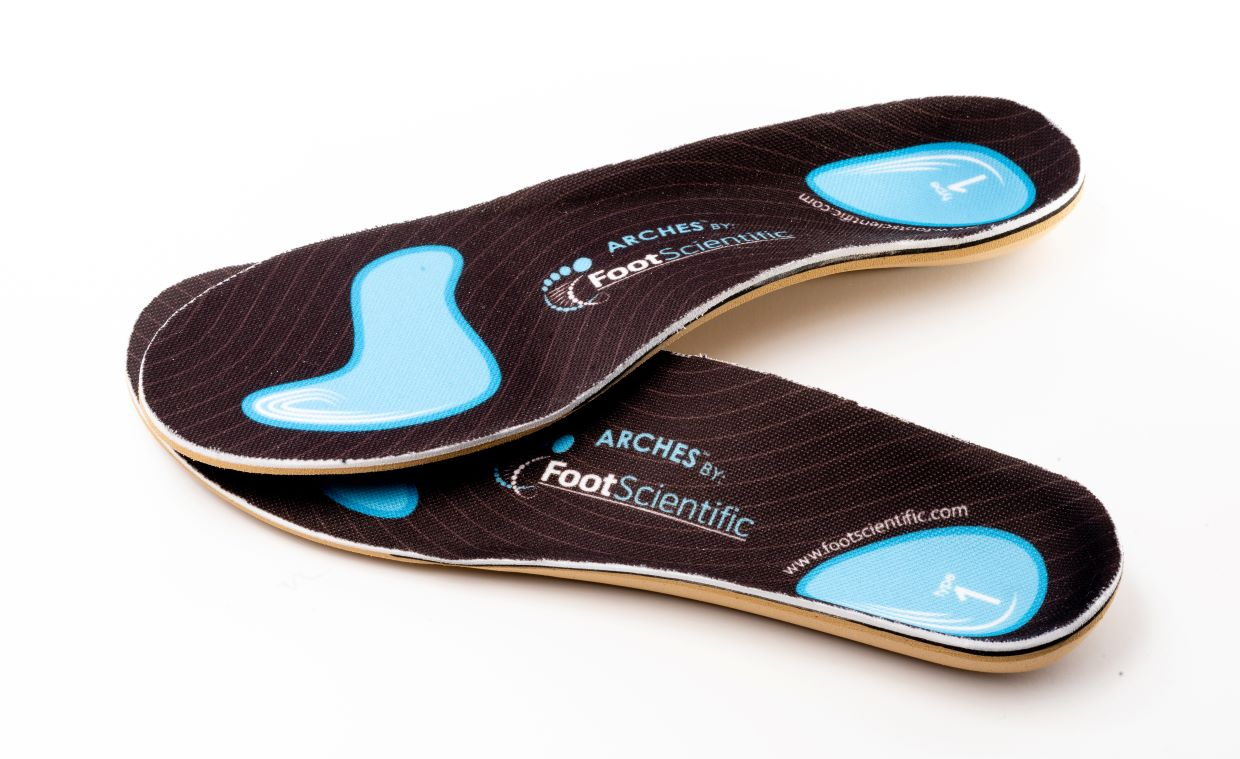
Phase one, offload. Take the strain off the fascia so it can calm down. This is where a corrective orthotic earns its place: it supports the arch and redistributes load so the fascia is no longer being overstretched with every step. Relative rest, meaning backing off the activities that spike the pain rather than stopping everything, belongs here too. The goal of phase one is simple, get the pain under control and the tissue out of constant overload.

Phase two, strengthen. Once the pain is controlled and daily walking is comfortable, you start building the calves, the intrinsic foot muscles, and the supporting chain. Crucially, you are strengthening on top of an offloaded fascia, not a raw one, so the work builds capacity instead of causing flares. The orthotic is not replacing this work. It is what made this work possible.
Phase three, wean if appropriate. As strength and mechanics improve, many people can reduce how much they rely on the orthotic, keeping it for higher-load days and long times on their feet. Some people, depending on their foot structure, benefit from ongoing support, and that is not dependency, more on that below.
This is the offload-first approach, and it is the philosophy the FootScientific Arches line was designed around by Dr. Rob Faux, a board-certified orthopedic surgeon: correct the load so the tissue can settle, so the body can do the rest.
A foot and calf strengthening progression
Think of this as a general progression, not a prescription. Start gentle, progress as pain allows, and stop anything that sharpens your symptoms. A physical therapist can tailor it to you, which is worth doing.
Early, while you are still offloading:
- Calf stretches and a gentle plantar fascia stretch
- Toe spreads and short-foot activation, learning to engage the arch
- Towel scrunches with the toes
As pain settles and daily walking is comfortable:
- Double-leg heel raises, progressing toward single-leg over time
- Controlled arch and toe strengthening with more load
Building toward resilience:
- Loaded calf and single-leg work under guidance
- Gradual return to the running or standing demands that matter to you
Progress by how the fascia responds, not by a calendar. If a level flares the pain, drop back a step. That responsiveness is the whole reason the offload phase comes first.

How to tell when you are ready to reduce orthotic use
There is no fixed date, but there are signs. You are likely ready to experiment with less orthotic reliance when your first steps in the morning are no longer painful, you can get through a normal day on your feet without the heel flaring, and your strengthening has genuinely progressed. When you do reduce, do it gradually rather than all at once, and keep the orthotic available for the highest-load days. If pain returns, that is information, not failure, ease back and give it more time.

Will I have to wear orthotics forever?
Not necessarily, and the honest answer has two parts. For a lot of people, orthotics are a tool used most heavily during the flare and the rebuild, and reliance drops as strength and mechanics improve. For others, usually those whose foot structure is the underlying driver, ongoing support genuinely helps, and using it long-term is not a sign your feet got weak. It is the same reason someone keeps wearing glasses. The support is correcting a structural reality, not creating a crutch. Either outcome is normal, and which one is yours depends on your feet, not on willpower.
Barefoot and minimalist shoes with plantar fasciitis: the timing problem
Minimalist and barefoot-style shoes are not the enemy, but the timing matters, and it is the same order-of-operations point. Dropping into minimalist footwear while your fascia is already irritated adds load to the exact tissue you are trying to calm, which is how a lot of people make a flare worse. If building toward more natural, less supported footwear is a goal, it is a phase-three goal, approached gradually once the pain is resolved and the foot is stronger, not a phase-one fix.

Can weak calves or glutes contribute to plantar fasciitis?
They can, and almost no one covers this. Your foot does not work in isolation. Tight or weak calves change how force travels through the heel and fascia, and weakness further up the chain, at the hips and glutes, can alter how you load the foot with every step. This is why a good strengthening plan rarely stops at the foot. It is also why "just strengthen your feet" is too small an instruction. The chain matters, which is a bigger topic worth its own guide.

Where FootScientific Arches fit
The Arches line exists to do the phase-one job well: correct the load so the fascia can settle and the strengthening can actually take hold. If you are not sure which type matches your foot, the complete guide to orthotics for plantar fasciitis walks through selection in detail.
COMPLETE GUIDE

Frequently Asked Questions
It depends on where you are in recovery. If you stop while the fascia is still overloaded, symptoms can return. If you reduce reliance gradually after the pain is controlled and your strength has improved, many people do fine with less support. Stopping abruptly during a flare is what tends to backfire.
No. A supportive orthotic does not switch your foot muscles off, your foot keeps working inside the shoe. For some foot structures, ongoing support genuinely helps long-term, which is correction, not dependency.
Through the offload and rebuild phase at minimum, worn consistently. Beyond that, it varies. Some people reduce reliance as they strengthen, others benefit from continued support. Let your symptoms and your clinician guide the timeline.
For some people, yes, with stretching, strengthening, load management, and time. Orthotics speed and stabilize the offload phase, especially when foot mechanics are part of the cause, but they are one tool, not the only path.
The main one is using them as the whole plan. Support without also strengthening and addressing the cause can leave you managing symptoms rather than resolving them. Used as phase one of a sequence, that downside disappears.
Stretching, progressive strengthening, load management, and footwear changes all help, and mild cases can resolve on those alone. The point of this guide is that it is rarely orthotics versus exercise, it is offload first, then strengthen.

FOOTSCIENTIFIC ARCHES ORTHOTICS
Type-matched support to offload the plantar fascia so it can settle and rebuild
Designed by Dr. Rob Faux, Board-Certified Orthopedic Surgeon
Shop Arches Orthotics →Medically reviewed by Dr. Rob Faux, Board-Certified Orthopedic Surgeon