

The Complete Guide to Orthotics for Plantar Fasciitis
QUICK ANSWER
Do orthotics work for plantar fasciitis? Yes, when matched to your foot type and combined with stretching. Research shows 85-95% of people improve within 6-12 months. Prefabricated medical-grade orthotics work as well as custom for most people. The key is matching the orthotic type to whether you have flat feet, high arches, or neutral arches.
You have plantar fasciitis. You have been told you need orthotics. Now you are staring at dozens of options ranging from $15 drugstore insoles to $600 custom devices, and you have no idea what actually matters.
This guide will tell you what the research says works, what does not, and how to choose the right orthotic for your specific foot type. No marketing fluff. Just evidence.

The Most Important Thing Most People Get Wrong
Here is what the research makes clear: the single most important factor in orthotic effectiveness is matching the device to your foot type.
A flat foot and a high-arched foot have opposite biomechanical problems. They need opposite solutions. Using the same "one size fits all" orthotic for both is like prescribing the same glasses to someone who is nearsighted and someone who is farsighted.
Yet this is exactly what most people do. They grab whatever orthotic is on sale or has good reviews, without knowing whether it matches their foot.
A finite element analysis published in Frontiers in Bioengineering and Biotechnology found that generic insoles without proper arch support failed to reduce plantar fascia strain in flat-footed patients. Only orthotic configurations with the right arch height and posting angle achieved the 5-15% strain reduction needed for pain relief.
Before you spend any money, you need to know your foot type. (This is exactly why we designed three distinct orthotic types rather than a one-size-fits-all product.)
Step 1: Identify Your Foot Type
The Wet Test
This takes 30 seconds:
-
Wet the bottom of your foot
-
Step onto a dark piece of paper or concrete
-
Look at your footprint
Flat Foot (Overpronation): Your footprint shows almost the entire sole. There is little or no curve on the inside. Your arch collapses when you stand.
High Arch (Supination): Your footprint shows only the heel, ball of foot, and a thin strip (or no strip) connecting them. The middle of your foot barely touches the ground.
Neutral: Your footprint shows a moderate curve on the inside. About half of your arch area makes contact.
The Clinical Method
Healthcare providers use the Foot Posture Index, which scores feet from -12 (highly supinated/high arch) to +12 (highly pronated/flat):
-
Flat feet: +5 to +12
-
Neutral: -5 to +5
-
High arch: -2 to -12
You do not need a formal assessment to make a good orthotic choice. The wet test is sufficient for most people.

Step 2: Understand What Your Foot Type Needs
If You Have Flat Feet
The problem: Your arch collapses under load, causing excessive inward rolling (pronation). This stretches the plantar fascia with every step.
What you need:
-
High arch support to lift and stabilize your collapsed arch
-
Medial posting (a wedge that tilts your foot slightly outward) to control pronation
-
Semi-rigid material that maintains its shape under load
What the research says: A computational study found that arch support height was the single most important factor for flat feet, accounting for 45.7% of the variance in pressure reduction. Medial posting angle was second at 25.5%.
Custom vs. prefabricated: For flat feet, research shows prefabricated orthotics work as well as custom. A randomized trial of 142 patients published in Clinical Rehabilitation found no significant difference between prefab and custom EVA insoles at 4 and 8 weeks. Save your money.
If You Have High Arches
The problem: Your rigid, elevated arch creates concentrated pressure points under your heel and ball of foot. Your foot does not absorb shock well.
What you need:
-
Cushioning and shock absorption
-
Total contact design that spreads pressure across more of your foot surface
-
Pressure redistribution rather than arch correction
What the research says: A study of 152 patients with high arches published in Gait & Posture found that pain relief correlated with how evenly pressure was distributed across the foot, not with how much peak pressure was reduced. Custom orthoses improved this distribution by 44%.
Custom vs. prefabricated: This is the one foot type where custom orthoses genuinely outperform prefabricated. The Cochrane systematic review found custom orthoses significantly more beneficial than prefab for high-arched feet. The rigid, highly individual nature of cavus feet requires precision fitting that mass-produced insoles cannot provide.
If You Have Neutral Feet
The problem: Your biomechanics are relatively normal. Your plantar fasciitis likely stems from overuse, inadequate footwear, or other factors rather than structural abnormality.
What you need:
-
Moderate arch support matched to your natural arch height
-
Balanced support without aggressive correction in either direction
-
Semi-rigid material with cushioned top cover
What the research says: A randomized trial published in BMC Musculoskeletal Disorders found that neutral-footed patients with plantar fasciitis achieved significant pain reduction (20.9mm at 4 weeks, 24.3mm at 12 weeks) with individualized arch support ranging from 26-48mm based on their specific anatomy.
Custom vs. prefabricated: For neutral feet, the difference is minimal. A quality prefabricated orthotic with appropriate arch support will work for most people.

Step 3: Know What Features Actually Matter
Research has identified specific orthotic features that reduce plantar fascia strain. Here is what the evidence supports:
Arch Support: The Most Important Feature
The landmark cadaveric study by Kogler published in Foot & Ankle International established that effective arch support must conform tightly to the medial longitudinal arch. Orthoses that gap from the arch provide no benefit.
A finite element analysis found that the arch support must contact at least 54% of the medial longitudinal arch surface to effectively reduce plantar fascial stress by 14% and peak pressure by 39%.
What to look for: An orthotic that matches your arch height and contour, not just a generic bump in the middle. When you place the orthotic against your foot (non-weight-bearing), it should follow the curve of your arch closely.
Heel Cup Depth: More Than Cushioning
Many people think heel cups just provide cushioning. Research shows they do something more important: they confine the heel pad.
A study using ultrasound elastography published in Clinical Biomechanics found that plastic heel cups reduced internal heel pad stress to 55.5% of baseline and increased heel pad thickness by 37.5%. The mechanism is confinement, not cushioning.
What to look for: A heel cup depth of at least 12mm. Deep heel cups (18-25mm) provide better rearfoot stabilization for plantar fasciitis.
Material: Semi-Rigid Beats Soft
Soft, squishy insoles feel comfortable but do not provide the support needed for plantar fasciitis.
The Landorf trial published in Archives of Internal Medicine compared soft foam (sham), firm foam (prefab), and semi-rigid plastic (custom). Both firm and semi-rigid significantly outperformed soft for pain and function.
A study on 3D-printed orthoses found that semi-rigid material (58±5 Shore-A hardness) effectively treated plantar fasciitis that had persisted beyond 6 weeks of conservative management.
What to look for: Avoid soft, squishy insoles that compress easily. Look for firm foam or semi-rigid plastic that maintains its shape when you press on it.
Posting Angle: Direction Matters
Posting refers to wedges built into the orthotic that tilt your foot. The direction matters enormously.
Cadaveric research published in Clinical Biomechanics found that:
-
Medial forefoot posting increased plantar fascia strain (bad)
-
Lateral forefoot posting decreased plantar fascia strain (good)
-
Rearfoot posting alone had minimal effect
This is counterintuitive. Many orthotic providers prescribe medial forefoot posting for pronation control, but the research suggests this may actually worsen plantar fascia tension.
What to look for: For flat feet with overpronation, medial rearfoot posting (3-6 degrees) combined with neutral or lateral forefoot is appropriate. Avoid aggressive medial forefoot wedges.

Step 4: Set Realistic Expectations
Timeline for Results
Do not expect immediate relief. Research shows a consistent pattern:
Weeks 1-2: Adaptation period. Some discomfort is normal as your feet adjust.
Weeks 4-6: Initial improvement. A randomized trial found first-step pain decreased by 20.9mm (on a 100-point scale) at 4 weeks.
Weeks 7-12: Maximum effectiveness. The meta-analysis of 19 trials found moderate-quality evidence for pain reduction in this window.
Beyond 12 weeks: Benefits plateau. The Landorf trial found no significant differences between orthotic groups and control at 12-month follow-up.
The bottom line: orthotics provide the most benefit in the 7-12 week window. They are a treatment tool, not a permanent cure.
Success Rates
Research shows 70-87% of patients achieve clinically important pain improvement with orthotics during the active treatment window.
However, approximately 45-50% of plantar fasciitis patients remain symptomatic at 5-10 years regardless of treatment, according to a long-term prognosis study published in Foot & Ankle International. Orthotics provide symptomatic management while the tissue heals, which takes an average of nearly 2 years.
Compliance Matters
The SOOTHE trial published in JOSPT measured exactly how much patients wore their orthotics: 6.6 days per week, about 10 hours per day. This near-daily, all-day wear correlated directly with pain reduction.
Sporadic use does not work. If you are only wearing orthotics occasionally, you will not see results.

What About Custom vs. Prefabricated?
This is the $500 question. Here is what the research actually shows:
The Meta-Analysis Answer
The Whittaker meta-analysis of 19 randomized trials (1,660 patients) published in the British Journal of Sports Medicine found no significant difference between prefabricated and customized orthoses at any timepoint for general plantar fasciitis populations.
The Foot Type Exception
The research does show one clear exception: high-arched (cavus) feet benefit more from custom orthoses.
A Cochrane review found custom orthoses significantly outperformed prefabricated for painful cavus feet. The mechanism is different: cavus feet need precision pressure redistribution that generic insoles cannot provide.
For flat feet and neutral feet, prefabricated orthotics matched to foot type perform equivalently to custom.
The Cost Reality
Custom orthotics typically cost $300-$600. Quality prefabricated orthotics cost $30-$80.
If you have flat or neutral feet, you are paying 5-10x more for no additional benefit. If you have high arches, the custom investment may be worthwhile.
The Buying Checklist
Use this checklist when evaluating any orthotic:
For Flat Feet (Overpronation):
-
[ ] Firm arch support that matches your collapsed arch height
-
[ ] Medial rearfoot posting (look for 3-6 degree wedge)
-
[ ] Deep heel cup (12mm minimum, 18-25mm ideal)
-
[ ] Semi-rigid material that does not compress easily
-
[ ] Designed specifically for overpronation/flat feet
For High Arches (Supination):
-
[ ] Cushioning and shock absorption
-
[ ] Total contact design (covers more of foot surface)
-
[ ] Lateral support to prevent excessive outward rolling
-
[ ] Consider custom if prefab does not provide relief
-
[ ] Designed specifically for high arches/supination
For Neutral Feet:
-
[ ] Moderate arch support matching your natural arch
-
[ ] Balanced design without aggressive correction
-
[ ] Semi-rigid material with cushioned top layer
-
[ ] Deep heel cup for rearfoot stability
For All Foot Types:
-
[ ] Fits in your primary shoes without crowding
-
[ ] Does not cause pressure points or blisters
-
[ ] Maintains shape when you press firmly on arch
Red Flags: What to Avoid
Soft, squishy gel insoles: They feel good initially but provide no meaningful support. Research shows soft materials underperform semi-rigid for plantar fasciitis.
"One size fits all" claims: Any company claiming their single orthotic works for all foot types is ignoring basic biomechanics.
Magnetic or copper insoles: No peer-reviewed evidence supports these claims.
Extremely rigid orthotics without proper indication: Rigid plastic orthoses are contraindicated for patients with arthritis and may cause problems in feet that do not need aggressive correction.
Custom orthotics as first-line treatment: Clinical guidelines recommend trying prefabricated orthotics first. Custom should be reserved for patients who fail prefab or have specific anatomical needs.
When to See a Professional
Consider professional evaluation if:
-
You have tried appropriate prefabricated orthotics for 6-8 weeks with no improvement
-
You have high arches and prefab orthotics are not providing relief
-
You have diabetes, neuropathy, or rheumatoid arthritis (these conditions require specialized fitting)
-
You have significant leg length discrepancy
-
Your pain is getting worse rather than better with orthotics
A podiatrist or pedorthist can perform a formal gait analysis, measure your foot posture index, and determine whether custom devices are truly necessary for your situation.
What We Recommend: The FootScientific Approach
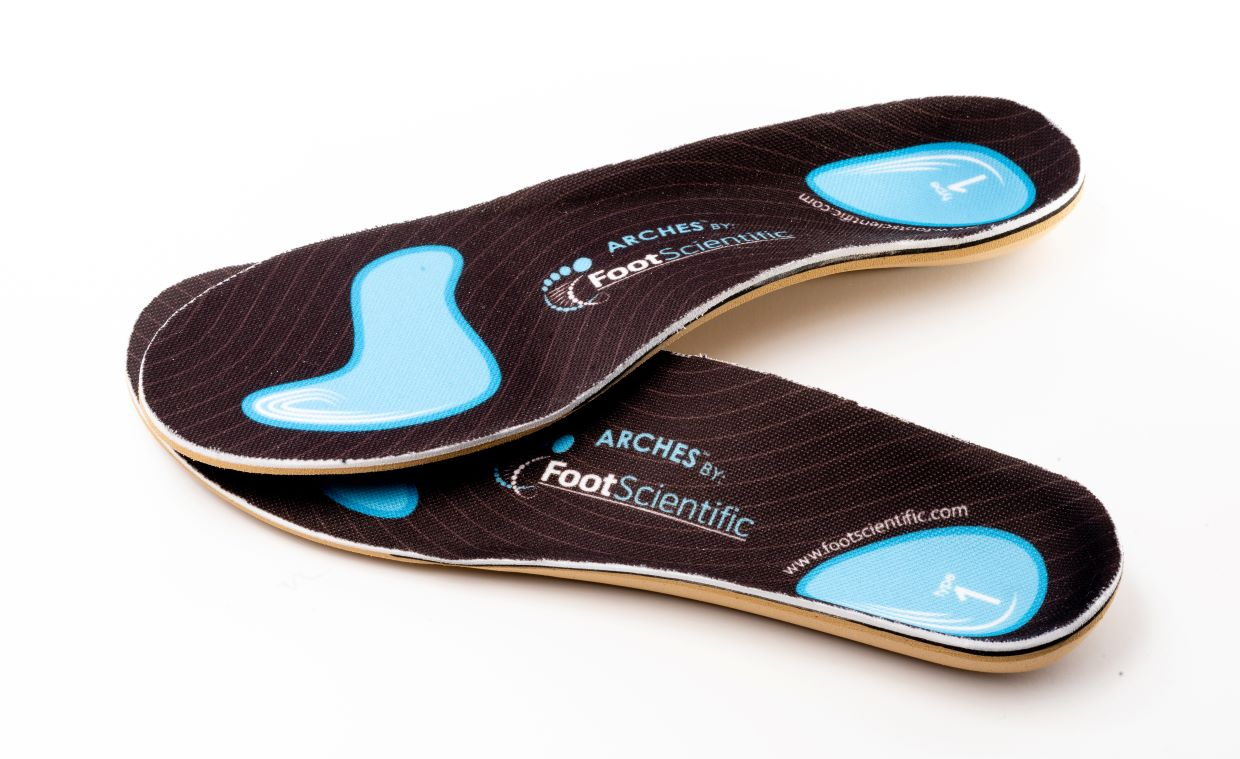
We built FootScientific's Arches Orthotics around the same principle this entire guide is based on: foot type determines what orthotic you need.
Rather than offering one "universal" orthotic and hoping it works for everyone, we developed three distinct types with the specific corrective features the research supports:
Type 1: For Flat Feet (Overpronation)
If the wet test shows a full footprint with little or no arch curve, you have flat feet that overpronate.
What Type 1 provides:
-
3° medial heel post that tilts your heel slightly outward, countering excessive pronation
-
Firm arch support matched to the collapsed arch structure
-
Deep heel cup for rearfoot stability
-
4-layer design with molded cork base for semi-rigid support
This matches exactly what the research says flat feet need: medial posting to control rearfoot eversion (the computational study found this accounts for 25.5% of pressure reduction) combined with high arch support (45.7% of variance in strain reduction).
Best for: Plantar fasciitis with flat feet, posterior tibial tendon pain, medial ankle discomfort, overpronation-related knee pain.
Type 2: For Neutral Feet
If the wet test shows a moderate curve on the inside with about half of your arch making contact, you have neutral feet.
What Type 2 provides:
-
Moderate arch support without aggressive correction
-
Balanced design that does not tilt your foot in either direction
-
5-layer design with additional shock-absorbing gel layer
-
Cushioning and pressure redistribution for all-day comfort
Neutral feet do not need the aggressive correction that flat or high-arched feet require. They need support and shock absorption. Type 2 provides this without overcorrecting.
Best for: Plantar fasciitis in neutral feet, metatarsalgia (ball of foot pain), general foot fatigue, people who stand all day.
Type 3: For High Arches (Supination)
If the wet test shows only your heel and ball of foot with a very thin strip (or no strip) connecting them, you have high arches.
What Type 3 provides:
-
3° lateral heel post that tilts your heel slightly inward, countering excessive supination
-
First metatarsal relief to accommodate the rigid high-arch structure
-
Pressure redistribution across more of the foot surface
-
4-layer design optimized for shock absorption
The research on high-arched feet shows pain relief comes from pressure redistribution, not just cushioning. Type 3's lateral posting and contoured design spreads pressure more evenly across the foot, which the Gait & Posture study found improved this distribution by 44%.
Best for: Plantar fasciitis with high arches, lateral ankle pain, recurrent ankle sprains, peroneal tendon issues, cavovarus foot deformity.
Why This Approach Works
The research is clear: matching orthotic features to foot type produces better outcomes than generic "one size fits all" devices.
FootScientific's Type 1/2/3 system gives you the foot-type-specific correction the studies support, at prefabricated pricing. You get the 3° medial or lateral posting, the appropriate arch support height, and the semi-rigid materials that clinical trials show work, without the $400-$600 custom orthotic price tag.
The bottom line: Identify your foot type with the wet test. Choose the matching FootScientific type. You will get research-backed corrective features designed for your specific biomechanics.

Frequently Asked Questions
Expert answers from Dr. Rob Faux, Board-Certified Orthopedic Surgeon
Arch support that matches your specific foot type. This is the single most important factor, and it's where most people go wrong.
A finite element study found that arch support height accounted for 45.7% of the variance in pressure reduction for flat feet. That's nearly half of what determines whether an orthotic actually helps you.
But here's the catch: the orthotic must conform closely to your arch contour—not just provide a generic bump in the middle. Research shows that orthoses which gap from your arch provide minimal benefit, no matter how expensive they are.
Before you buy anything, use the wet test to identify your foot type (flat, neutral, or high arch), then choose an orthotic designed specifically for that structure. A $50 orthotic matched to your foot type will outperform a $400 orthotic that isn't.
Learn more: The Complete Guide to Orthotics for Plantar Fasciitis
The wet test takes 30 seconds and tells you everything you need to know.
Here's how to do it:
- Wet the bottom of your foot
- Step onto a dark piece of paper or concrete
- Look at your footprint
Flat feet (overpronation): Your footprint shows almost the entire sole with little or no inner curve. Your arch collapses when you stand. You need Type 1 orthotics with firm arch support and medial posting.
High arches (supination): Your footprint shows only the heel and ball of foot with a very thin strip—or no strip—connecting them. You need Type 3 orthotics with lateral support and pressure redistribution.
Neutral feet: Your footprint shows a moderate curve with about half of your arch making contact. You need Type 2 orthotics with balanced support.
This simple test is sufficient for most people. You don't need a formal clinical assessment to make a good orthotic choice.
For most people, no. The research on this is surprisingly clear.
A meta-analysis of 19 randomized trials involving 1,660 patients, published in the British Journal of Sports Medicine, found no significant difference between prefabricated and custom orthotics for general plantar fasciitis populations.
That means if you have flat feet or neutral feet, you're paying 5-10x more for custom ($300-$600) versus quality prefabs ($30-$80) with no additional benefit.
The one exception: high-arched (cavus) feet. A Cochrane review found that custom orthotics significantly outperformed prefab for painful high arches. The rigid, highly individual nature of cavus feet requires precision pressure redistribution that mass-produced insoles can't provide.
The bottom line: Try quality prefabricated orthotics first. If you have high arches and don't get relief after 6-8 weeks, then consider the custom investment.
Learn more: Custom Orthotics vs Prefabricated: Do You Really Need to Spend $600?
Research shows a consistent pattern. The maximum effectiveness window is 7-12 weeks.
Here's what to expect:
- Weeks 1-2: Adaptation period. Some discomfort is normal as your feet adjust to proper support.
- Week 4: Initial improvement. A randomized trial found first-step pain decreased by 20.9mm on a 100-point scale at this point.
- Weeks 7-12: Maximum benefit. This is supported by moderate-quality evidence from a meta-analysis of 19 trials.
- Beyond 12 weeks: Benefits plateau. One trial found no significant differences between orthotic groups at 12-month follow-up.
Important: If you see no improvement after 6-8 weeks of consistent daily wear, something isn't right. Either the orthotic doesn't match your foot type, or there may be another issue that needs evaluation. Don't keep pushing through—reassess your approach.
Orthotics are a treatment tool, not a permanent cure. It's important to have realistic expectations.
What orthotics do is provide symptomatic management while the tissue heals. They reduce pain during this process, which research shows takes an average of nearly 2 years for complete resolution.
A long-term study published in Foot & Ankle International found that approximately 45-50% of patients remain symptomatic at 5-10 years regardless of treatment. And only about 24% of patients can eventually discontinue orthotics entirely.
That sounds discouraging, but here's the perspective: 70-87% of patients achieve clinically important pain improvement with orthotics during the active treatment window. They make the healing process much more manageable.
Think of orthotics like glasses for your feet. They correct the underlying mechanical problem that causes strain. For many people, continued use is part of long-term foot health—not a failure of treatment.
References:
-
Peng Y, et al. Optimal Design of an Insole for Improving Plantar Pressure Distribution. Front Bioeng Biotechnol. 2022. Frontiers
-
Baldassin V, et al. Effectiveness of prefabricated and customized foot orthoses made from low-cost foam for noncomplicated plantar fasciitis. Arch Phys Med Rehabil. 2009. PubMed
-
Landorf KB, et al. Effectiveness of Foot Orthoses to Treat Plantar Fasciitis. Arch Intern Med. 2006. JAMA
-
Najafi B, et al. Mechanism of orthotic therapy for the painful cavus foot deformity. Gait Posture. 2014. PMC
-
Bishop C, et al. Custom foot orthoses improve first-step pain in individuals with unilateral plantar fasciopathy. BMC Musculoskelet Disord. 2018. PMC
-
Whittaker GA, et al. Foot orthoses for plantar heel pain: a systematic review and meta-analysis. Br J Sports Med. 2018. BJSM
-
Landorf KB, et al. Effectiveness of Foot Orthoses Versus Corticosteroid Injection (SOOTHE trial). J Orthop Sports Phys Ther. 2019. JOSPT
-
Hansen L, et al. Long-term prognosis of plantar fasciitis. Foot Ankle Int. 2018. PubMed
This guide is for educational purposes and is not a substitute for professional medical advice. If you have persistent heel pain, consult with a qualified healthcare provider for proper diagnosis and treatment recommendations.