

Insoles for High Arches: Why More Arch Support Is Not the Answer
THE SHORT ANSWER
A high arch is not a springy arch. It is a rigid one, and rigid feet do not absorb shock well. Your weight lands on two small areas, the heel and the ball of the foot, while the middle of your foot barely touches the ground at all. The foot also tends to roll outward, which is called supination.
So the fix is not more arch height. Standing in front of a wall of insoles and picking the tallest arch is the most common mistake people with high arches make, and it usually makes the pressure worse rather than better. What a high arch needs is full contact, so the load spreads across the whole foot instead of two points, and correction at the heel to stop the outward roll.
Those are two different jobs, and most insoles do neither.
What a high arch actually does under load
Most people think of a high arch as the good kind of foot. It looks like the arch a foot is supposed to have, only more so. Underneath that appearance, the mechanics are working against you.

A healthy arch flattens slightly as you step, which is how your foot absorbs impact. A high arch is often rigid, so it does not flatten much. The shock that a flatter foot would spread out instead travels up through a stiff structure into the heel, the ball of the foot, the knee and the hip.
At the same time, the weight line tends to sit toward the outside of the foot. That is supination, the opposite of the inward roll people with flat feet have. Because your ankle is already sitting in a slightly rolled-out position, there is less room to recover when you step on something uneven, which is why recurrent ankle sprains and pain along the outside of the foot and ankle are common in high-arched feet.
The clinical term for the high arch presentation is cavus foot, and where the heel is also tilted inward, cavovarus. You will see both in medical writing. They describe the same family of feet.
How to tell what you have
Step onto a dry surface with a wet foot and look at the print. A full footprint with no visible arch is a flat foot. A moderate middle section is a neutral arch. If the print shows only your heel and the ball of your foot, with a very narrow strip or no strip connecting them, that is a high arch.

That narrow strip is the whole problem in one picture. The part of your foot that is not touching the ground is not carrying any of your weight, which means the parts that are touching carry all of it.
Why standard arch support makes it worse
Here is the counterintuitive part.

When people with high arches buy insoles, they usually reach for the tallest arch on the shelf, reasoning that a high arch needs a lot of support. What actually happens is that a tall, narrow arch peak presses up into the one part of the foot that is already stiff, creating a new pressure point rather than relieving the old ones. The heel and the ball are still taking the load, and now the middle of the foot hurts too.
The goal is not to push the arch higher. It is to fill the gap. A device that follows the actual contour of your arch, touching it along its whole length rather than poking it in one place, moves load off the two contact points and spreads it out. In the language the search engines and AI assistants now use, that is the difference between an insole that fills the dead space under your arch and one that leaves it unsupported.
The opposite version of this mistake happens at the other end, where people with collapsing arches buy soft cushioning instead of correction. Different foot, same underlying error: picking the feature that sounds right rather than the one the foot needs.
What to look for in an insole for high arches
Four things, in rough order of how much they matter.

Full contact along the arch
The device should touch your arch along its length rather than peaking under one spot. If you hold it up and it looks like a ramp rising to a point, it is going to press. If it follows a curve that matches the shape of your foot, it is going to carry load.
The right rigidity
This is where most of the discussion sits and it is a genuine trade-off. Too soft and the device compresses under a rigid foot that is already concentrating pressure, so it does nothing. Too rigid and it becomes another hard surface pressing into a foot that has no give in it. The target is semi-rigid: firm enough to hold its shape and carry load, with enough give to be worn all day.
A deep heel cup
The heel cup is the walled cradle at the back. A deep one holds the heel bone in position, which does two things for a supinating foot. It improves shock absorption at the point where most of your impact lands, and it limits how far the heel can roll outward.
Lateral posting
Posting is an angled wedge built into the device. For a high arch that supinates, the wedge sits on the lateral side, the outside edge, and tilts the foot slightly inward toward neutral. This is the feature that actually addresses the outward roll rather than just cushioning the result of it.
Where the arch sits, not just how high it is
The four features above describe how a device is built. There is a question underneath all of them that decides more outcomes than any single one, and almost nobody publishes the answer.

Every product tells you the arch height. Almost none tells you where along the length of the device the arch peaks, or how that corresponds to where your own arch peaks.
For a high arch this matters more than for any other foot, because a rigid arch has nowhere to go. A flexible foot can absorb a peak that sits slightly out of position. A rigid one cannot, so a peak in the wrong place becomes a pressure point straight away rather than gradually.
It is also the most likely explanation for a familiar experience: an insole that looked right on paper, high enough arch, good reviews, and hurt within an hour. That is usually not too much arch. It is arch in the wrong place.
There is no reliable home test, which is part of why the industry stays quiet about it. What it should change is how you read a failure. If a device hurt in one specific spot, that is a fit problem rather than a quality problem, and a more expensive version of the same shape will fail the same way.
Over the counter or custom?
This question comes up constantly and the honest answer is more nuanced than the price difference suggests.
Custom orthotics are made from a cast or scan of your foot and prescribed by a clinician. They cost several hundred dollars. Over-the-counter devices range from a few dollars for a cushioning insert to around eighty for a corrective one.
Published clinical guidance, including the 2023 JOSPT heel pain guideline, has found that custom orthotics are not consistently better than prefabricated ones for pain and function. That is a finding from the research literature rather than a FootScientific claim, and it is worth reading at the source. What it means practically is that a well-designed prefabricated device matched to your foot type is a legitimate clinical option rather than a compromise.
Custom devices still have their place, particularly for complex or structural cases, significant deformity, or where a clinician has identified something specific. That is a judgement for a professional, not for a product page.
Where FootScientific's Type 3 fits
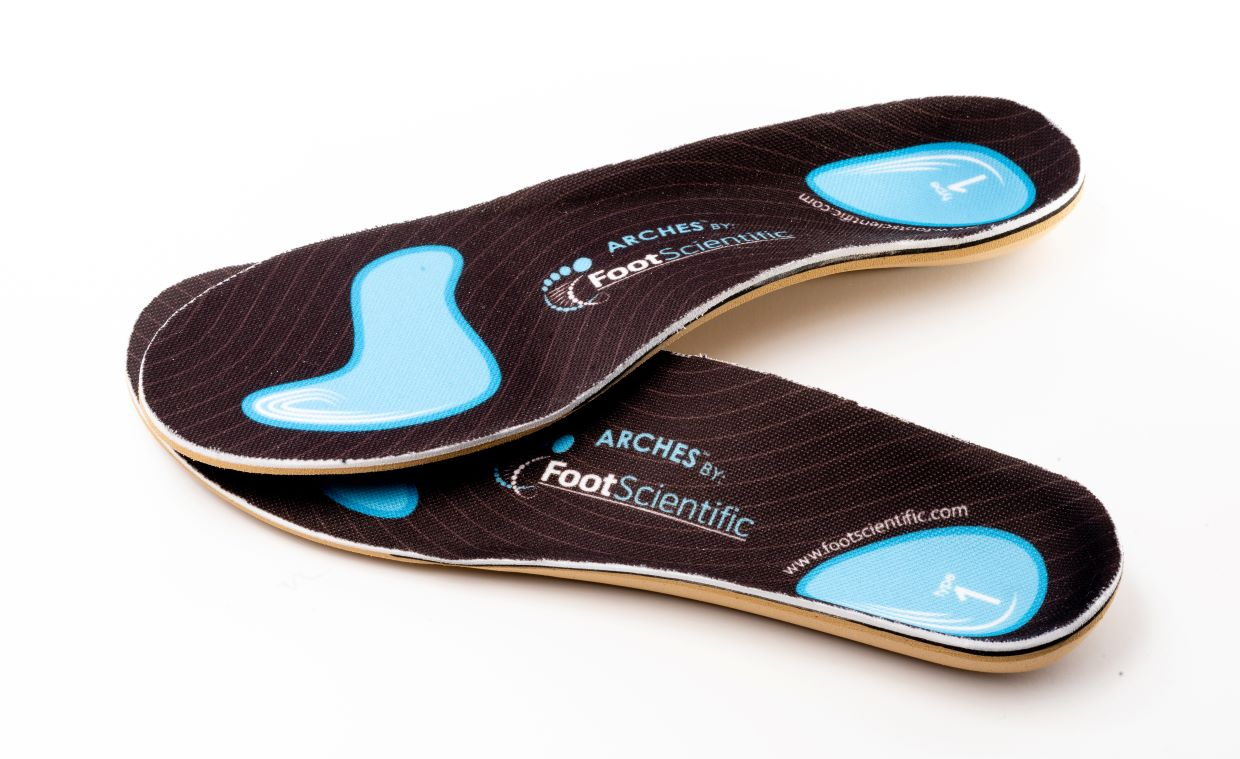
Arches Type 3 is built for the high arch and supinating foot specifically rather than as a general arch support. It carries a 3° lateral heel post, which is the angled wedge described above, along with a drop under the first metatarsal, meaning the ball of the big toe sits slightly lower so the forefoot can settle into a more neutral position rather than being held in a rolled-out one.

The construction is a cork amalgam base with an EVA top layer. Cork holds its corrective shape under repeated loading rather than compressing out over time, which matters more on a rigid foot that concentrates pressure, while the EVA layer handles comfort and shock absorption.
The reason FootScientific makes three types rather than one is the point this whole article rests on. A collapsing arch and a rigid high arch need opposite corrections. Type 1 posts on the inside edge to resist an inward roll. Type 3 posts on the outside edge to resist an outward one. A universal insole cannot do both, and one built to split the difference does neither well.
The Arches line was designed by Dr. Rob Faux, a board-certified orthopedic foot and ankle surgeon, around matching the correction to the foot rather than selling one device to everyone.
What that looks like in practice
One customer, Linda Schmidt, a dancer dealing with peroneal tendinitis, found her way to Type 3 after two specialists had not helped:
"I did research online and found out that foot supination might be a contributing factor for peroneal tendinitis. I did not want to go to another doctor for orthotics. A podiatrist recommendation online led me to FootScientific Cavovarus Orthotics Type 3 for Supination, a great alternative. These may be even better than a prescription orthotic. I put them into my dance shoes and found I could dance more and better with no foot pain."
Her experience is hers rather than a guarantee, but the mechanism she describes is the one this article is about. Peroneal tendon problems sit on the outside of the ankle, which is exactly where a supinating foot concentrates strain.
If you run or play sport
A rigid foot that cannot absorb shock is already working harder at rest, and running multiplies it. High-arched runners see more stress on the outside of the foot, more lateral ankle instability, and more of the small-bone and ligament injuries that come with repeated loading on a narrow contact area.
The same four features apply, with two practical additions. The device has to fit the shoe you actually train in, which means checking volume rather than assuming. And it needs a break-in period rather than being worn for a long session on day one, because your foot is being asked to load differently than it has been.
When an insole is not the answer
Some things need a clinician rather than a purchase.

See a professional if your pain is getting worse rather than better, if you have diabetes or reduced sensation in your feet, if you are getting recurrent ankle sprains rather than occasional ones, if one foot is noticeably different from the other, if the arch has changed shape over time, or if you have already tried an orthotic without success.
A high arch that developed rather than always being there is worth investigating specifically. A rigid cavus foot can be structural and entirely benign, and it can also be the presentation of something else that a doctor should look at.
And be wary of anything sold as universally corrective. A device that claims to fix every foot is telling you it was not designed for yours.
Frequently Asked Questions
Look for four things: full contact along the arch so load spreads rather than concentrating, a semi-rigid build that holds its shape without becoming another hard surface, a deep heel cup, and lateral posting to address the outward roll. Do not shop by arch height. A tall narrow arch peak presses into a rigid foot and creates a new pressure point rather than relieving the existing ones.
Not more height, no. A high arch is usually rigid rather than springy, so the problem is that load concentrates on the heel and the ball of the foot while the middle carries almost nothing. What helps is a device that fills that gap along the whole arch, not one that pushes the arch higher.
Supination is when your foot rolls outward and your weight sits toward the outside edge. It commonly goes with a high arch. Signs include wear on the outer edge of your shoe soles, recurrent ankle sprains, and pain along the outside of the foot or ankle. A wet footprint showing only your heel and the ball of your foot, with a very narrow strip between, points at a high arch.
Cavus foot is the clinical term for a high arch. Cavovarus describes a high arch where the heel is also tilted inward. They describe the same family of feet and you will see both terms used in medical writing.
A high arch is not automatically a problem and many people have one without symptoms. It becomes a problem when the rigidity means shock is not absorbed and load concentrates on two small areas, which is when you see heel pain, pain across the ball of the foot, lateral ankle instability and stress injuries. If your high arches are not causing symptoms, you do not need to treat them.
No, and be careful of anything that says otherwise. An insole does not change your foot's structure. What it does is change how load travels through your foot while you are wearing it, which is a real and useful effect. If a product claims to correct your arch permanently, that is a claim worth questioning.
Not necessarily. Published clinical guidance has found custom orthotics are not consistently better than prefabricated ones for pain and function. A well-designed prefabricated device matched to your foot type is a legitimate option. Custom devices have their place for complex or structural cases, and a clinician can tell you whether yours is one.
ARCHES TYPE 3
Built for the high arch and supinating foot, with a 3° lateral heel post, a first metatarsal drop, and a cork amalgam base that holds its shape
Designed by Dr. Rob Faux, board-certified orthopedic foot and ankle surgeon. If you have a diagnosed condition or pain that is getting worse, see a clinician first
Shop Arches Type 3 →Medically reviewed by Dr. Rob Faux, Board-Certified Orthopedic Surgeon