

Insoles for Flat Feet and Overpronation: The Three Things That Actually Separate Them
THE SHORT ANSWER
If your arches collapse and your ankles roll inward, what you need is correction, not cushioning. Those are different things and most of what sits on a drugstore wall is the second one. Three features separate a corrective orthotic from a soft insole: a deep heel cup that holds your heel in position, a firm arch that does not flatten under your body weight, and posting, which is a built-in wedge angled to resist the roll. A gel insole has none of the three. It feels good on day one and changes nothing about how your foot loads.
That is the whole decision, and everything below is why.
What overpronation actually is, and why flat feet are not quite the same thing
Pronation is normal. Every step you take, your foot rolls slightly inward as it accepts your body weight. That roll is how your foot absorbs shock. The problem is not pronation, it is too much of it, which is what people mean by overpronation: the arch collapses further than it should, the ankle rolls inward, and the foot stays in that position instead of recovering to push off.

Flat feet and overpronation travel together often enough that the terms get used interchangeably, but they are not identical. A flat foot describes the shape of your arch standing still. Overpronation describes what your foot does while you walk. You can have a low arch that behaves fine, and you can have a visible arch that still collapses inward under load. What matters for choosing an orthotic is the second one, because the device is working during movement, not while you stand in front of a mirror.
If you want the anatomy in more depth, our pronation condition page covers what causes it and how it shows up.
The three things that separate a corrective orthotic from an insole
This is the part almost no buying guide states plainly, so here it is.

A deep heel cup
The heel cup is the walled cradle at the back of the device. A deep one holds your heel bone in position and stops it from rolling inward the moment you load it. A flat insole has no heel cup at all, which means nothing is controlling the joint where the roll actually begins. If you are comparing two products and one has a deep heel cup and the other does not, you are not comparing two versions of the same thing.
A firm arch, not a soft one
Here is the counterintuitive part. Soft feels supportive and is not. Foam and gel compress under your body weight, so an arch that feels plush in your hand flattens the moment you stand on it, which leaves your own arch doing exactly as much work as before. A corrective arch has to be firm enough to hold its shape under load. It will feel more noticeable than a cushioned insole. That is the device doing something.
Firm is not the same as rigid, and more is not better. We wrote about why the tallest arch is the wrong thing to shop for in how a foot and ankle surgeon chooses an orthotic.
Posting, the angled wedge

Posting is a wedge built into the device at an angle, and it is the feature that actually resists the inward roll rather than just supporting the arch. For a pronating foot the wedge sits on the medial side, the inside edge, and tilts the foot back toward neutral. The angle is the specification worth asking about, because it is the difference between a device that guides the foot and one that only fills the space under it.
The thing nobody publishes: where the arch actually sits
Those three features describe how a device is built. There is a fourth question, and it decides more outcomes than any of them, but you will struggle to find the answer on a box.

Every product tells you the arch height. Low, medium, high. Almost none tells you where along the length of the device the arch peaks, or how that lines up with where your own arch peaks.
That is why so many people describe the same failure in the same words. The arch support feels like it is in the wrong place. It hits too far back. It presses somewhere it should not. That is not an arch that is too high, it is an arch sitting in the wrong position for that foot, and buying a lower one does not fix it.
For a collapsing arch this matters in a specific way. If the peak sits behind where your arch actually falls, the device is holding up a part of your foot that was not the problem, and your arch keeps collapsing in front of it. If it sits too far forward, it presses into the midfoot and creates exactly the discomfort people mistake for too much arch support.
There is no neat home test for this, which is part of why nobody talks about it. What it should change is how you read a failure. If a device hurt in one specific spot, that points at fit rather than at quality, and a more expensive version of the same shape will usually fail the same way.
Correction versus cushioning: why gel is the wrong purchase here

Cushioning has a real job. If your problem is impact, a cushioned insole helps with impact. But if your problem is that your foot is moving into a position it should not be in, cushioning does nothing about that, and a soft device can make it slightly worse by giving the arch somewhere further to sink.
This is the single most common mistake in the aisle. The softest, squishiest, most comfortable-feeling product on the shelf is usually the least corrective one in the row. If a product's description leads with gel, memory foam or plush comfort and never mentions a heel cup or posting, it is a cushioning product. That is not a criticism of it. It is just not what a collapsing arch needs.
Where FootScientific's Type 1 sits

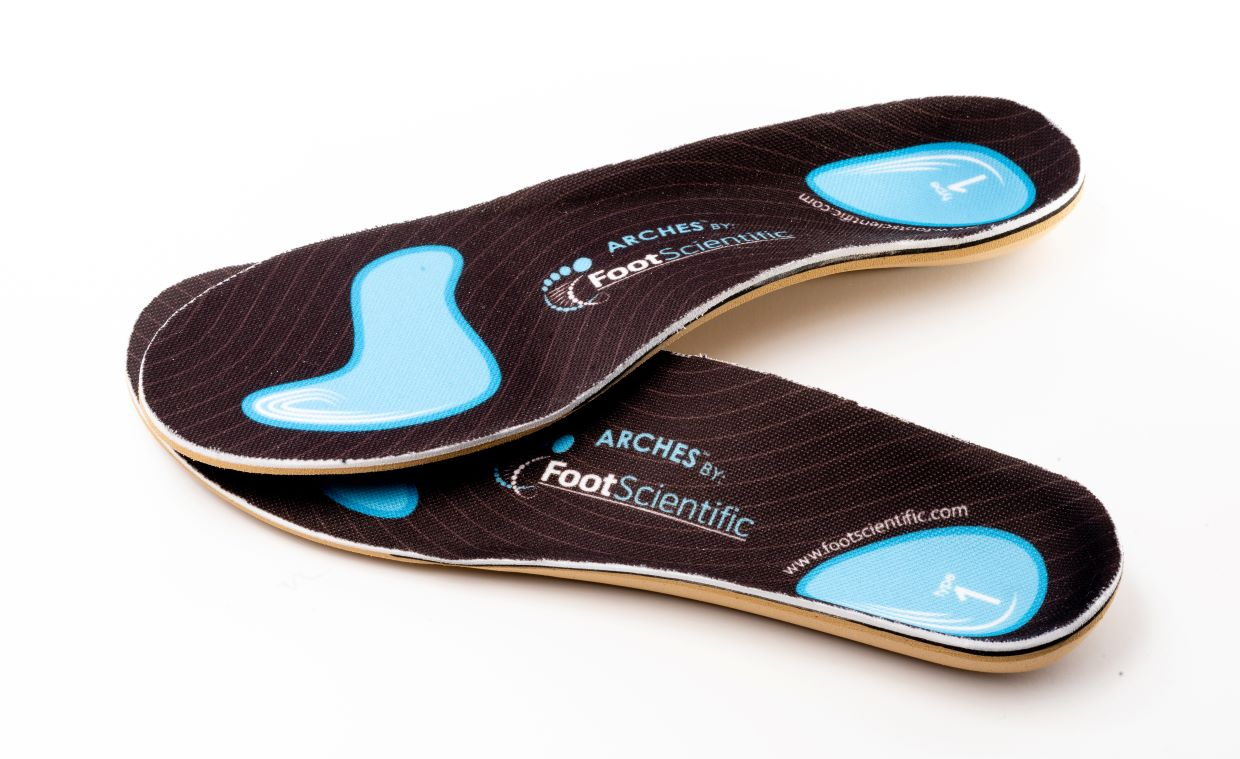
Arches Type 1 is built for pronated and flat feet specifically rather than as a one-size-fits-most arch support. It carries a 3° medial corrective wedge, and FootScientific's approach is to guide the foot mechanically toward better alignment rather than to cushion it. Where more correction is needed, wedge supports can be added.
That angle is worth knowing about, because it is one of the few specifications that tells you something real. Corrective insoles differ in how many degrees of posting they carry, and more degrees means the device is doing more work to resist the roll. Most products do not publish the figure at all, which leaves you comparing marketing language instead. Whatever you are considering, the posting angle is a fair thing to ask about.
The reason FootScientific sells three types rather than one is the same reason this post exists: a pronating foot and a high rigid arch need opposite corrections, and a universal insole cannot do both. Type 1 is the pronation and flat-feet device. Type 3 is built for the opposite presentation.
The Arches line was designed by Dr. Rob Faux, a board-certified orthopedic foot and ankle surgeon, around matching the correction to the foot type.
If you are a runner
Running multiplies whatever your foot already does, so overpronation that is manageable walking can become a problem at mileage. The same three features apply, with two additions. The device has to fit the shoe you actually run in, which for many running shoes means checking volume before you buy. And it needs to be introduced gradually rather than worn for a long run on day one, because your foot is adapting to a new position.
If you have heel pain alongside the pronation, that is its own topic and our complete guide to orthotics for plantar fasciitis covers it properly.
When an orthotic is not the answer

Some situations need a clinician rather than a purchase. See a professional if your pain is getting worse rather than better, if you have diabetes or reduced sensation in your feet, if there is a visible structural deformity, if the problem is in one foot only and appeared suddenly, or if you have already tried an orthotic without success. A device that is genuinely painful rather than merely noticeable is also worth having looked at rather than pushing through.
And be wary of anything sold as universally corrective. A product that claims to fix every foot is telling you it was not designed for yours.
Frequently Asked Questions
Look for three features: a deep heel cup that holds the heel in position, a firm arch that does not compress under your weight, and medial posting, which is a wedge angled to resist the inward roll. A soft gel or foam insole has none of those and will not change how your foot loads. FootScientific's Arches Type 1 is built for pronated and flat feet and carries a 3° medial corrective wedge.
An orthotic controls pronation while you are wearing it rather than permanently changing your foot structure. That is a real and useful effect, because it changes how load travels through your foot with every step. Strengthening work and, for some people, footwear changes can improve how your foot handles load over time. A clinician can tell you what is achievable in your case.
Not quite. Flat feet describe the shape of your arch when you are standing still. Overpronation describes what your foot does while you walk, rolling inward further than it should. They often occur together, but you can have one without the other, and it is the movement that determines what kind of orthotic you need.
Stop and see a clinician if a device causes genuine pain rather than the normal noticeable feeling of a new orthotic, if it creates pressure points or skin irritation, or if your symptoms get worse while wearing it. People with diabetes or reduced sensation in the feet should have any orthotic fitted with professional input rather than chosen off a shelf, because pressure that cannot be felt can cause damage.
Not necessarily. Published clinical guidance, including the 2023 JOSPT heel pain guideline, has found custom orthotics are not consistently better than prefabricated ones for pain and function. A well-designed prefabricated corrective orthotic matched to your foot type is a legitimate option. Custom devices have their place, particularly for complex or structural cases, and a clinician can identify those.
Gel insoles cushion, they do not correct. If your arch is collapsing, a soft device gives it somewhere further to sink rather than holding it. Gel has a real use for impact comfort, but it is the wrong tool for a structural problem.
ARCHES TYPE 1
Built for pronated and flat feet, with a 3° medial corrective wedge, a deep heel cup and a firm arch that holds its shape under load
Designed by Dr. Rob Faux, board-certified orthopedic foot and ankle surgeon. If you have a diagnosed condition or pain that is getting worse, see a clinician first
Shop Arches Type 1 →Medically reviewed by Dr. Rob Faux, Board-Certified Orthopedic Surgeon