

Types of Drop Foot Braces
Comparing AFOs, Dynamic Braces, and FES Devices

THE SHORT ANSWER
The best drop foot brace depends on your specific needs. Solid AFOs provide maximum support for severe weakness. Carbon fiber AFOs offer lightweight energy return. External braces allow normal shoe wear and adjustable lift. FES devices actively stimulate muscles. Research shows AFOs and FES produce equivalent functional improvements. Cost ranges from $24 for basic prefab to $15,000+ for implantable FES.

Choosing the right drop foot brace can be overwhelming. The market includes traditional plastic AFOs, modern carbon fiber designs, external braces, and high-tech functional electrical stimulation devices. Each has distinct mechanisms, advantages, and limitations.
This guide compares the evidence behind each option to help you and your healthcare team make an informed decision.

Traditional Ankle-Foot Orthoses (AFOs)
Solid (Rigid) AFOs
Solid AFOs feature a rigid plastic shell that completely restricts ankle movement, maintaining the foot in a neutral position throughout the gait cycle.

Best for:
- Severe muscle weakness
- Significant spasticity
- Marked medial-lateral instability
- Maximum ankle control needed
Limitations:
- 32% of patients report discomfort
- 42% dislike appearance
- 87% report sweating issues
- Requires shoes 0.5-1 size larger
- Less natural gait pattern
Articulated (Hinged) AFOs
Articulated AFOs incorporate a mechanical ankle joint allowing controlled motion, typically permitting dorsiflexion while limiting plantarflexion.
Benefits:
- More natural ankle kinematics than solid AFOs
- Springs can prevent foot slap (2-17 Nm resistance)
- Adjustable as patient function changes
- Reduces muscle co-contraction
Cost: $645-$707 for base models plus modifications

Carbon Fiber AFOs
Carbon fiber AFOs use composite materials to create thin, strong orthoses with excellent strength-to-weight ratios and energy return properties.

Key advantages:
- 15% lower energy expenditure compared to walking without bracing
- 50% lighter than comparable plastic AFOs
- 67% of stroke patients preferred carbon fiber in trials
- Energy storage and release during gait
- Thinner profile fits standard footwear better
Cost: $621-$707+ | Cannot be heat-adjusted post-fabrication
External (Outside-the-Shoe) Braces
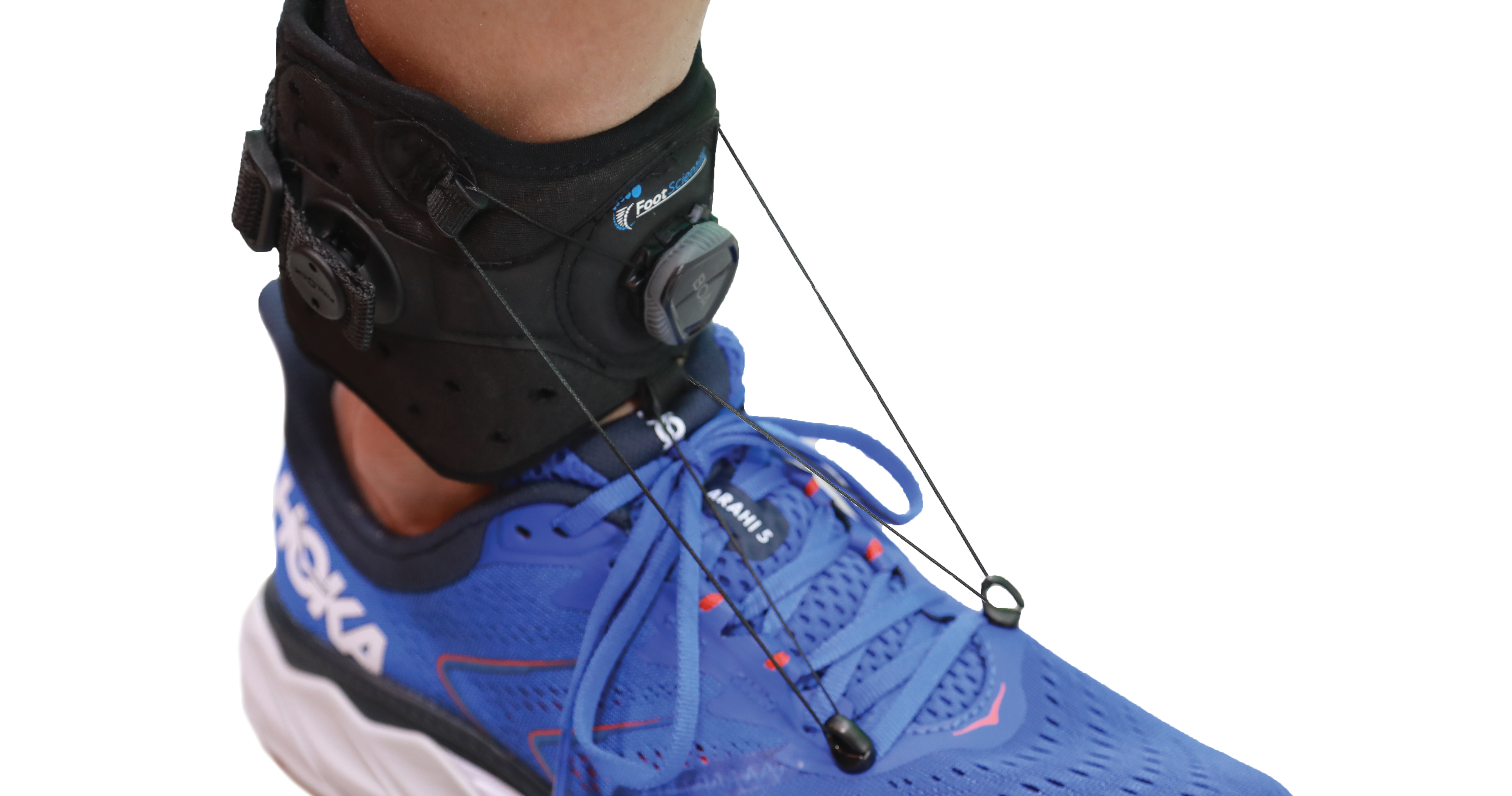
External braces represent a fundamentally different approach: the dorsiflexion-assist mechanism attaches outside the shoe rather than inside.

How External Braces Work
Mechanisms include:
- Cord/strap systems: Adjustable tension cables pull the foot upward during swing phase
- Spring-loaded mechanisms: PEEK material rods flex during stance and recoil during swing
- Dial adjustment systems: BOA technology allows micro-adjustment of dorsiflexion angle
Key Advantages
- Normal footwear: Works with existing shoes, sandals, boots
- Better ventilation: Addresses the 87% sweating complaints with traditional AFOs
- Adjustable throughout day: Modify support based on activity or fatigue
- Faster donning/doffing: No shoe insertion required
- Improved compliance: Addresses major barriers to AFO adherence
The Elevate Drop Foot Brace
Designed by board-certified orthopedic surgeon Dr. Rob Faux, the Elevate uses BOA technology for precision adjustment:

- BOA dial system: Micro-adjustable dorsiflexion control with one-hand operation
- Spectra cord: High molecular density polyethylene for durability
- 8 oz weight: Lightweight construction minimizes fatigue
- Quick release: Pull dial outward for immediate tension release
- Eyelet hook kit: Attaches to existing shoe eyelets
Functional Electrical Stimulation (FES)
FES devices electrically stimulate the common peroneal nerve to activate dorsiflexor muscles during walking, providing active rather than passive support.

Common FES Devices
- WalkAide: Surface stimulation, battery-powered, approximately $4,500
- Bioness L300: Surface stimulation with gait sensor, $4,000-$6,000
- ODFS Dropped Foot Stimulator: Research-validated surface FES
- Implantable systems: $15,000+ plus surgical costs
FES Effectiveness
Research shows FES improves:
- Walking speed
- Walking distance
- Energy expenditure
- Quality of life
- MS patients showed walking speed gains maintained at 3-year follow-up
FES vs AFO: The Evidence

Meta-analyses show AFOs and FES produce equivalent functional improvements for stroke-related drop foot. The choice depends on:
- Nerve status: FES requires intact peripheral nerves
- Spasticity: AFOs may be better with significant spasticity
- Cost: AFOs significantly less expensive
- Patient preference: Some prefer the active feel of FES
- Lifestyle: FES allows barefoot walking
Cost Comparison

| Brace Type | Cost Range |
|---|---|
| Prefabricated AFO | $24-$400 |
| Custom Plastic AFO | $476-$1,092 |
| Carbon Fiber AFO | $621-$1,000+ |
| External Braces | $200-$500 |
| Surface FES Devices | $4,000-$6,000 |
| Implantable FES | $15,000+ plus surgery |
Insurance: Most insurance covers prescribed AFOs with prior authorization. FES coverage varies significantly by plan. Average annual AFO management costs approximately $1,200 per patient, offset by preventing fall-related injuries that can cost up to $30,000 per incident.


Frequently Asked Questions
The best brace depends on your specific situation: weakness severity, spasticity, shoe preferences, lifestyle, and budget. Solid AFOs suit severe weakness; carbon fiber for energy efficiency; external braces for normal footwear; FES for active strengthening. Many patients benefit from trying multiple options with professional guidance.
Research shows 37% of AFO users struggle with compliance. Top complaints include heat/sweating (87%), needing special shoes, discomfort (55%), and cosmetic concerns (42%). External braces and carbon fiber AFOs address many of these issues through better ventilation, shoe compatibility, and lighter weight.
Meta-analyses show equivalent functional improvements. FES offers active strengthening and barefoot capability but costs 10-20x more and requires intact peripheral nerves. AFOs are more cost-effective and work regardless of nerve status. The "best" option depends on individual factors.
External braces attach outside the shoe rather than inside. This allows normal footwear, better ventilation, and adjustable support throughout the day. The Elevate brace uses BOA dial technology for micro-adjustable lift control with one-hand operation.

ELEVATE DROP FOOT BRACE
External design | BOA micro-adjustment | Works with your existing shoes
Designed by Dr. Rob Faux, Board-Certified Orthopedic Surgeon
Shop Elevate Drop Foot Brace →Sources
1. AFO patient satisfaction research: 32% discomfort, 42% appearance concerns, 87% sweating.
2. Carbon fiber AFO studies: 15% lower energy expenditure, 67% patient preference.
3. AFO vs FES meta-analyses: equivalent functional improvements.
4. Cost data from Medicare reimbursement rates and manufacturer sources.
Medically reviewed by Dr. Rob Faux, Board-Certified Orthopedic Surgeon