

What Is BOA Technology in Medical Braces? A Patient's Guide to the Dial
THE SHORT ANSWER
BOA is a dial-based closure system that replaces laces or straps with the turn of a small dial. In a medical brace, that dial sets and adjusts the device's fit, and on a drop foot brace specifically, it lets you change your lift angle without taking the brace off.
That last part is the whole point, so the rest of this guide explains what BOA is, how the dial works, and why being able to adjust through the day matters when drop foot does not hold still.

What is the BOA Fit System?
The BOA Fit System is a closure mechanism built around a dial. Instead of tying laces or cinching straps, you turn a dial to tighten and pull it to release. It has been used for about 25 years across snowboard boots, cycling shoes, work boots, and other gear where a precise, secure fit matters and fumbling with laces does not cut it.
The three parts: the dial, the lace, and the guides
Every BOA closure has the same three components:
- A micro-adjustable dial, the part you turn.
- A thin, strong lace or cable that the dial winds in and out.
- Low-friction guides that route the lace so tension spreads evenly instead of bunching in one spot.
Turn the dial and the lace draws in evenly. Pull the dial and the tension releases. That even, dial-controlled tension is what makes it more uniform and more repeatable than laces you tie by hand.

Where you have probably seen it before
If a BOA dial looks familiar, it is because the same system shows up on snowboard boots, cycling and running shoes, hiking boots, and work boots. That heritage is worth knowing, because it means the mechanism has been field-tested for years in mud, ice, and one-handed-with-gloves conditions before it ever went on a brace.

Who makes it, and why a brace company licenses it
BOA is made by BOA Technology, founded in 2001. It is a third-party system that other companies license rather than build themselves. FootScientific licenses BOA for the Elevate Drop Foot Brace instead of engineering its own dial, which is worth saying plainly, because it means an independent source, BOA's own site, lists and describes the Elevate. For the lace, FootScientific selected a durable high-molecular-density polyethylene, chosen after testing as the longest-lasting option, and it is replaceable.
How does the BOA dial work?
In practice it is simple. Turn the dial clockwise and it winds the lace in, tightening the fit a little with each click. When you want it loosened or off, you pull the dial out and the tension releases at once.
What "micro-adjustable" means in practice
Micro-adjustable means you are not stuck with a few preset holes the way you are with a strap or a buckle. You can nudge the fit by small amounts, tighten a touch more, back it off a touch, until it sits right. And because it is a dial, you can do it with one hand, seated, without unlacing or removing anything.

What changes when BOA is on a drop foot brace instead of a boot
On a snowboard boot, the dial tightens the boot around your foot. On a drop foot brace, the same dial is doing something different: it is setting how much your foot is lifted.
From tightening a boot to setting a lift angle
Drop foot means you cannot lift the front of your foot on your own, so it drops and catches as you walk. A drop foot brace holds the foot up so it clears the ground. On a BOA brace, the dial is what sets and holds that lift. Turn it to add lift, release it to take the lift off.

Dorsiflexion, in plain language
Dorsiflexion is the medical word for lifting the front of your foot toward your shin, the motion drop foot takes away. When you read that a brace "supports dorsiflexion," it means the brace does that lifting for you. On a BOA brace, the dial is the control for how much.

What the Elevate uses
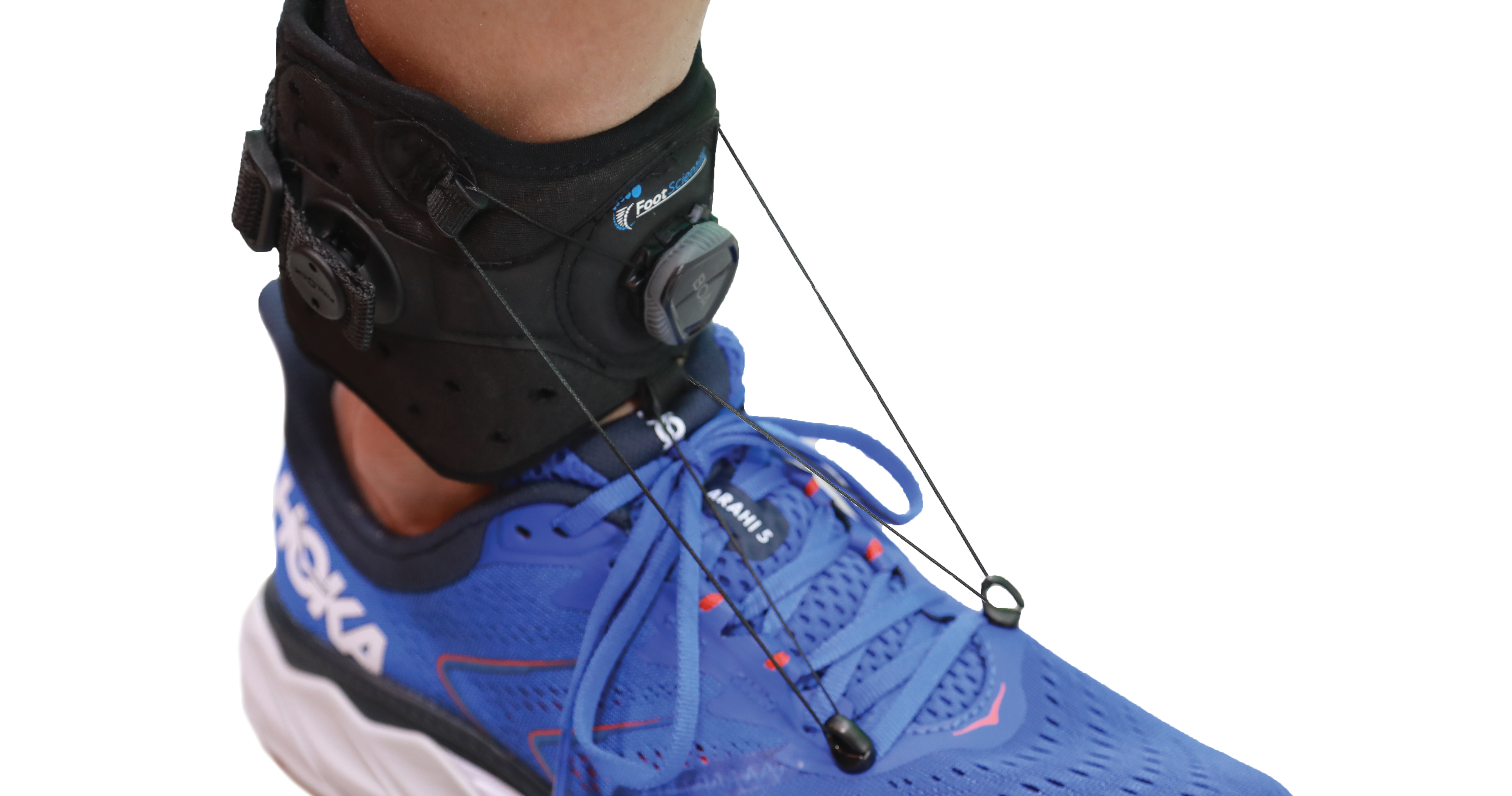
The Elevate Drop Foot Brace uses the BOA dial and lace. It sits outside the shoe rather than inside it, and the dial sets the lift angle you can adjust through the day.
Why day-to-day adjustment matters when drop foot fluctuates
Here is the argument for the dial, and it is a quality-of-life argument, not a spec sheet.
Drop foot does not hold still. Your leg in the morning is not your leg by evening.
Swelling, fatigue, and the difference between morning and evening
Feet and ankles swell over the day. Muscles fatigue. The lift that felt right at 8 a.m. can feel like too much, or too little, by dinner. A brace set once, with a fixed strap or a tied cord, is tuned for one version of your leg. Every hour after that, it is slightly off.

Fluctuating conditions
For a lot of people the change is bigger than a single day. Multiple sclerosis symptoms fluctuate. Post-stroke recovery shifts week to week. Peroneal nerve injuries change as they heal. A fit that is right this month may not be right next month.
Different shoes, different days
A thick boot and a thin flat do not hold your foot the same way, so the lift you want can change with the shoe.
The alternative
With a fixed brace, adjusting means stopping, taking it off, re-rigging it, and putting it back on. The dial replaces all of that with a turn you can do one-handed, seated, without removing your shoe. That is the difference the mechanism makes.

BOA braces versus straps, laces, and cord braces
Different drop foot braces adjust in different ways. Here is how the closure types compare, in general terms:
| Closure type | How you adjust it | Change it mid-day? | One-handed? |
|---|---|---|---|
| Dial (BOA) | Turn to tighten, pull to release | Yes, without taking it off | Yes |
| Hook-and-loop straps | Peel back and re-set | Possible, but fiddly | Usually two hands |
| Fixed cord or bungee | Set once at setup | Not without re-rigging | No |
| Rigid inside-shoe AFO shell | Not wearer-adjustable, set by a clinician | No | No |
The point is not that one closure is right for everyone. It is that if adjustability through the day matters to you, the dial is the mechanism built for it.


Common Questions
You turn a dial that winds in a thin, strong lace through low-friction guides, which tightens the fit evenly. Pulling the dial releases the tension. It is the same three-part system, dial, lace, and guides, on everything BOA is used on.
Yes, for their core job. A drop foot brace lifts the front of the foot so it clears the ground as you step, which reduces tripping and the outward leg-swing people use to compensate. How well any specific brace suits you depends on your diagnosis, which is a conversation for your clinician.
It depends on the cause and severity, and severe or complex cases should be guided by an orthotist or physical therapist. FootScientific reports the Elevate is used across a range of severities, but the right device for a severe case is a decision to make with your provider, not from a web page.
BOA systems are built for durability, and the lace is replaceable. One point of honesty that most pages skip: BOA's own lifetime guarantee explicitly does not cover medical products, so do not assume the consumer guarantee applies to a brace. The Elevate's BOA lace is designed for extended daily use and is replaceable, and FootScientific includes a replacement lace with the brace.
It varies widely by type. Rigid custom AFOs are the most expensive, since they are individually made. Prefabricated braces cost far less. For current Elevate pricing, check the product page, since prices change and this guide is meant to stay accurate over time.
Sometimes, depending on the cause. Some cases improve as the underlying issue heals, and some are longer-term. Because it can change, a brace you can adjust as you go is useful either way. Your clinician can tell you what to expect for your specific cause.
BOA was founded in 2001 and was acquired by Compass Diversified in October 2020.
It depends on the brace. Some sit inside the shoe and some outside. The Elevate sits outside the shoe and attaches to anchors set into your existing footwear, so it works with the shoes you already own. Our guide on wearing normal shoes with a drop foot brace covers this in detail.
Talking to your PT or orthotist about an adjustable brace
If an adjustable brace sounds like a fit, bring these questions to your appointment:
- Is my drop foot likely to change through the day or over time, and would adjustability help me?
- Is an outside-the-shoe brace appropriate for my severity and my goals?
- What lift and fit should I be starting with?
An adjustable brace is a tool, and your PT or orthotist can tell you whether it suits your specific situation.
The Elevate Drop Foot Brace
The Elevate is FootScientific's outside-the-shoe drop foot brace, designed by Dr. Rob Faux, a board-certified orthopedic surgeon, with Dr. Chris Hughes. It uses the BOA dial to set an adjustable lift angle, and it works with the shoes you already own.

ELEVATE DROP FOOT BRACE
BOA micro-adjustment | Adjustable lift angle | Works with your existing shoes
Designed by Dr. Rob Faux, Board-Certified Orthopedic Surgeon
Shop Elevate Drop Foot Brace →Medically reviewed by Dr. Rob Faux, Board-Certified Orthopedic Surgeon