

Can I Wear Normal Shoes With a Drop Foot Brace? Yes, If the Brace Goes Outside
THE SHORT ANSWER
Yes. You can wear normal shoes with a drop foot brace if the brace sits outside the shoe instead of inside it. A brace like the Elevate attaches to small anchors in the shoes you already own, so you keep your footwear, including boots and sandals, without buying special adaptive shoes.
If you have spent hours searching for shoes that fit over your brace, this is the part nobody told you: the problem might not be your shoes.

Why your normal shoes don't fit over a traditional AFO
A traditional ankle-foot orthosis, the rigid AFO most people are prescribed, is worn inside the shoe. It wraps the back of your calf and the sole of your foot with a molded shell, and that shell takes up the space your foot normally fills. So the shoe has to get bigger to make room.
That is why the usual advice sends you hunting for extra depth, wider widths, and removable insoles, and why so many people end up buying shoes a full size up or in two different sizes. If you have read through the drop foot threads on Reddit and Facebook, you already know how much of that search ends in frustration. The shoe search is real, and it is exhausting, and it is not your fault.

The standard advice, covered honestly
If your brace goes inside your shoe, here is what genuinely helps, and it is worth knowing:
- Extra-depth shoes, which add vertical room for the shell
- Wider widths, sometimes up to 6E, to fit the brace around the foot
- Shoes with removable insoles, so you can pull the factory insole and reclaim depth
- Adaptive footwear with stretchy or elastic laces for easier entry
- Sizing up, or buying two different sizes when one foot wears the brace
This advice is not wrong. If you are committed to an inside-the-shoe AFO, these are the right moves, and pages full of retailer collections and adaptive-shoe brands exist to serve exactly this. But it solves the problem one shoe at a time.

What that advice actually costs you
Here is the cost the shoe search hides. Every pair of brace-compatible shoes solves the problem for that one pair. The dress shoes you already own, the boots you like, the sandals you want in summer, none of them are covered. To wear the brace with them, you would need to replace each pair with an adaptive version, and you would pay that cost again for every future pair you buy, for as long as you wear the brace.
For a lot of people, whole categories just fall off the list. Sandals in particular tend to become impossible, because there is nowhere for an inside-the-shoe brace to go.

The other option: a brace that goes outside the shoe
There is a different way to solve this, and it flips the problem. If the brace does not go inside the shoe, the shoe does not have to change at all. An outside-the-shoe brace attaches to your existing shoe and lifts your foot from the outside, so you keep the footwear you already own. If you want the wider picture, our guide to external braces versus traditional AFOs compares the two approaches in depth.


How the BOA dial replaces the shoe as the tensioning point
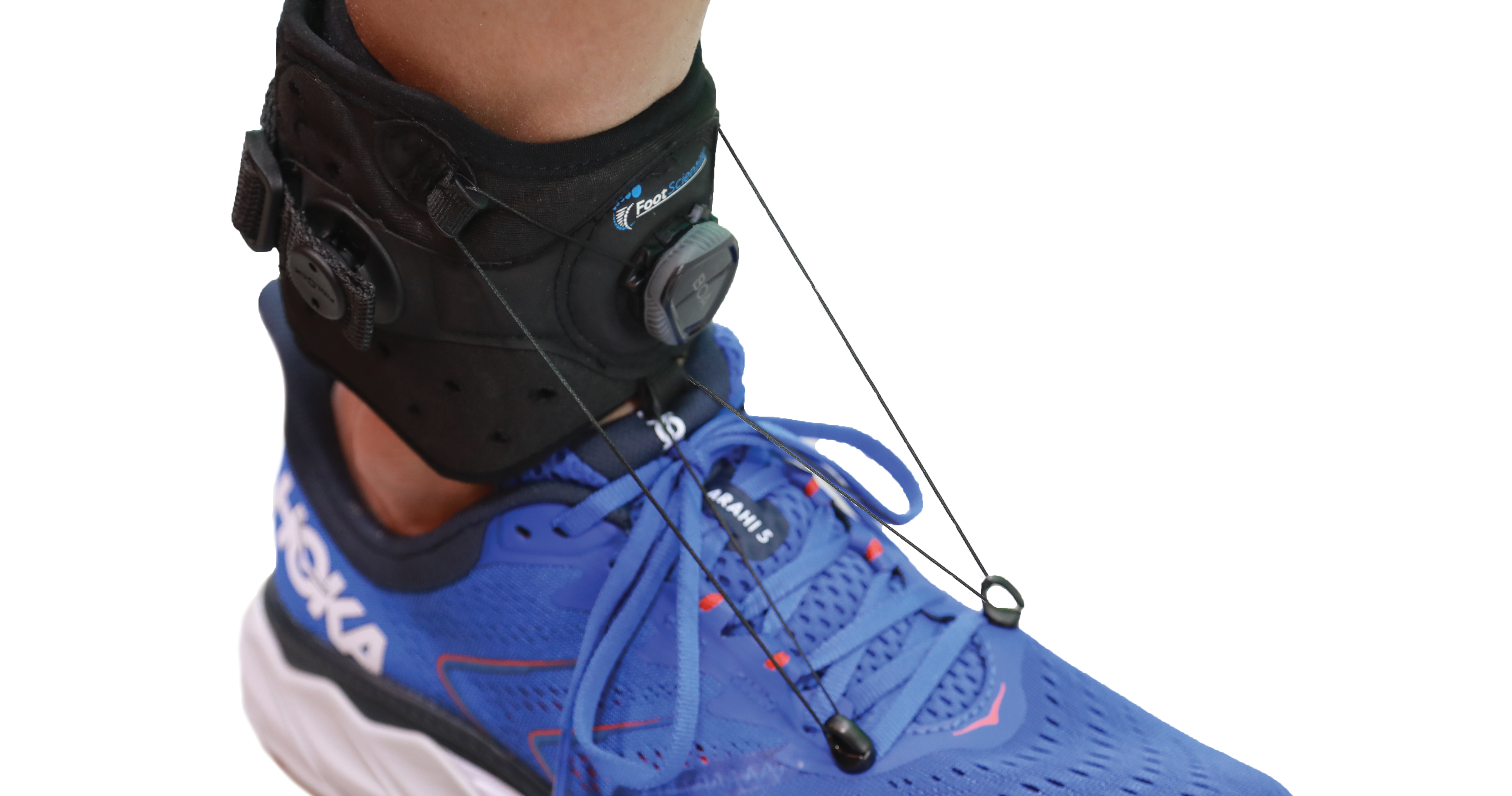
The Elevate is an outside-the-shoe drop foot brace. Instead of a rigid shell inside your shoe, it uses a durable lace connected to a BOA dial and clipped to small stainless-steel anchors that set into your shoe's eyelets. The dial sets your lift angle, and you can fine-tune it or release the tension at any point in the day with a turn or a pull. The whole brace weighs about eight ounces.

A few things follow from that design:
- The anchors stay in the shoe once they are set, so day to day you just clip in the lace and go. You can buy extra anchor kits to keep several pairs of shoes ready.
- Because the anchors can be placed on the inside or outside of the shoe, the brace can correct side-to-side motion, eversion and inversion, not only lift the toes straight up.
- Because it sits outside the shoe and lets your ankle keep moving, it helps your stabilizing muscles stay active rather than letting them weaken the way they can inside a rigid shell.


Elevate versus a traditional inside-the-shoe AFO
The short contrast: a rigid AFO is a fixed shell worn inside a shoe that has to be sized around it, with a set lift angle. The Elevate is an adjustable brace worn outside almost any shoe you already own, with a lift angle you can change through the day.

One honest note, because it matters for your research: the Elevate is not the only brace that sits outside the shoe. If you are comparing outside-the-shoe options, the details worth checking are whether the lift angle can be adjusted through the day or is fixed, whether it corrects side-to-side motion or only lifts straight, and how many of your actual shoes it works with. Those three questions are the design choices behind the Elevate. Our guide to the types of drop foot braces walks through the full range.
What about boots and sandals?
This is where an outside-the-shoe brace does something an inside-the-shoe AFO simply cannot. The Elevate works with almost any shoe, including boots, formal shoes, and sandals. For sandals and shoes without eyelets, the anchors can be set into most materials with an awl or a small screwdriver, and popular sandal brands have worked well for FootScientific customers.

If sandals have been off your list since you started wearing a brace, this is the reason to keep reading. Almost nothing on the internet answers "can I wear sandals with a drop foot brace" with a real yes, because for most braces the honest answer is no.

When you still need a custom AFO
Outside-the-shoe bracing is not right for everyone, and it would be dishonest to say otherwise. Significant spasticity, serious ankle instability, specific alignment needs, or a clinician's decision that you need a rigid, custom device are all real reasons an inside-the-shoe AFO may be the correct choice for you.
The Elevate was designed by Dr. Rob Faux, a board-certified orthopedic surgeon, together with Dr. Chris Hughes, specifically to address how many patients struggle to wear a traditional AFO every day. It is built to raise daily comfort and compliance across a wide range of drop foot severity. But the right device depends on your diagnosis, so bring the outside-the-shoe option to your provider and decide together.


Frequently Asked Questions
With an inside-the-shoe AFO, you generally need extra-depth or wider shoes with removable insoles. With an outside-the-shoe brace like the Elevate, you wear the shoes you already own, because the brace attaches to the shoe rather than fitting inside it.
There are adaptive shoes built with extra depth and easy-entry laces for people who wear an inside-the-shoe AFO. They help, but you buy them per pair. An outside-the-shoe brace removes the need for special shoes, since it works with your existing footwear.
Inside-the-shoe AFOs fit best in extra-depth shoes with a removable insole and a wider width, often sized up. If you would rather not replace your shoes, an outside-the-shoe brace attaches to the shoes you have instead.
Yes. A drop foot brace is designed to lift the front of your foot so it clears the ground as you step, which reduces tripping and the need to swing your leg outward to compensate. The Elevate does this while letting your ankle keep moving.
Many people wear a brace throughout their active day, and comfort is a big part of whether that actually happens. Your prescribed wear schedule should come from your clinician, since it depends on your diagnosis, your skin, and your goals.
With most inside-the-shoe AFOs, no. With the Elevate, yes. Because it attaches to the outside of the footwear, the anchors can be placed on sandals and open footwear, which is something an inside-the-shoe brace cannot accommodate.
ELEVATE DROP FOOT BRACE
External design | BOA micro-adjustment | Works with your existing shoes
Designed by Dr. Rob Faux, Board-Certified Orthopedic Surgeon
Shop Elevate Drop Foot Brace →Medically reviewed by Dr. Rob Faux, Board-Certified Orthopedic Surgeon