

Insoles for Achilles Tendonitis: What Helps, What Doesn't and When to See a Doctor
THE SHORT ANSWER
Insoles can help with Achilles tendonitis by reducing strain on the tendon, but they work best as one part of a plan rather than the whole fix. The right insole steadies your heel and supports your foot so the tendon isn't pulled at an awkward angle with every step. Gradual calf strengthening, sensible changes to activity and the right shoes do the rest. If your pain came on suddenly with a pop or a snap, skip the insoles and get seen right away.
What's happening in your Achilles
The Achilles tendon connects your calf muscles to your heel bone. It's the strongest tendon in the body and it takes a huge load every time you walk, climb stairs or push off to run.
Achilles tendonitis is irritation of that tendon from overuse. It usually shows up as stiffness or pain at the back of the heel or a few inches above it, often worst first thing in the morning or at the start of activity. Our Achilles tendonitis condition page covers the causes and symptoms in more detail. This post is about what you put in your shoe.
How your foot affects your Achilles
The tendon attaches to the back of the heel, so anything that changes how your heel moves changes how the tendon is loaded.
If your heel rolls inward or outward as you walk, the tendon gets pulled at an angle instead of straight up and down. Over thousands of steps a day that adds up. A high rigid arch can also make the foot less able to absorb shock, which leaves more of the work to the tendon and the calf.

That's where an insole helps. A deep heel cup holds the heel steady. A firm arch keeps the foot from collapsing or rolling. Together they help the tendon work in a straighter line.
What to look for in an insole for Achilles tendonitis
- A deep heel cup that holds your heel in position rather than letting it roll.
- A firm arch that holds its shape. Soft insoles compress and stop doing their job, especially by the end of the day.
- A design matched to your foot type. A flat foot and a high arch load the tendon differently, so one insole for everyone is a compromise.
- A comfortable heel. Cushioning under the heel can make the first steps of the day more tolerable, as long as it sits on top of real support.

Heel lifts: what they do
Heel lifts are small wedges that raise the heel inside the shoe. Raising the heel shortens the distance between the calf and the heel bone a little, which reduces stretch on the tendon. That's why they're one of the most common recommendations for Achilles tendonitis.

A few things worth knowing:
- Heel lifts are usually a short-term tool to calm things down, not a permanent fix.
- Put one in both shoes, not just the sore side, unless a clinician tells you otherwise, so you're not walking unevenly.
- The right height varies. A clinician can tell you what makes sense for you.
- If you already wear a corrective orthotic, don't stack a separate heel lift on top of it without advice. Adding height under the heel can change the correction the orthotic was designed to make.

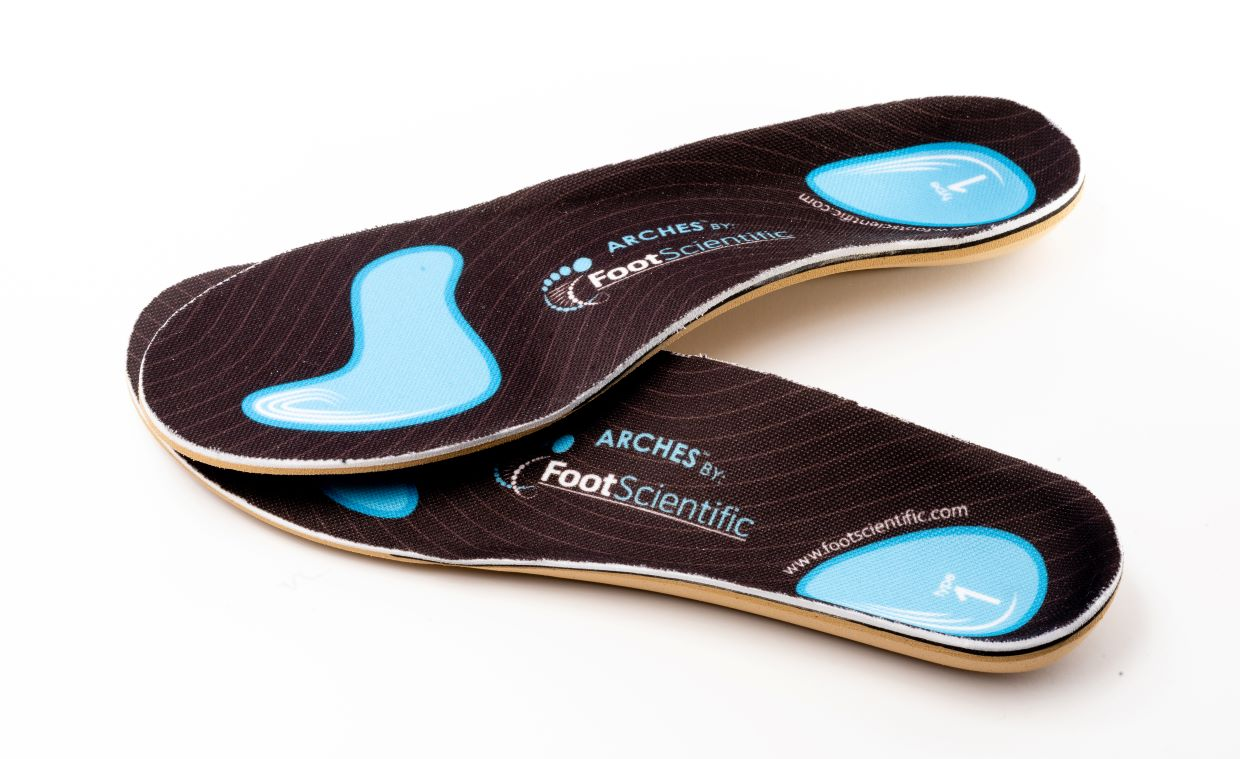
None of the Arches orthotics has a built-in heel lift. Instead, FootScientific offers corrective wedges for Type 1 and Type 3 that are designed to work with those orthotics when a foot needs more correction.
Which Arches orthotic fits your foot
Achilles tendonitis shows up in very different feet, so the right orthotic depends on your foot type.
High, rigid arch: Type 3
If you have a high rigid arch, your foot is one of the more likely to struggle with heel and Achilles problems. A high arch tends to keep the foot rigid and load the outside of the foot and the heel instead of spreading the work.
Arches Type 3 was designed by Dr. Rob Faux, a board-certified orthopedic foot and ankle surgeon, for exactly this foot. It uses a 3° lateral heel post and relief under the first metatarsal to bring a high rigid arch toward a more neutral position, taking pressure off key tendons. Heel and Achilles problems are one of the issues it was designed to help with. Our guide to insoles for high arches explains why more arch support isn't the answer for this foot.

Flat feet or overpronation: Type 1
When the arch collapses and the ankle rolls inward, the heel tilts with it and the Achilles is pulled at an angle with every step.
Arches Type 1 carries a 3° medial corrective wedge that guides the foot back toward neutral, so the heel and tendon can work in a straighter line. We explain more in insoles for flat feet and overpronation.

Not sure which you have?
Try the wet foot test. Wet the sole of your foot and step onto a dry concrete surface or a piece of dark paper. A nearly full footprint points to a flat foot. A print that shows mostly the heel and the ball of the foot, with a thin band or nothing between them, points to a high arch.

Insoles work best alongside strengthening
Clinical guidance for Achilles tendon pain consistently puts progressive calf strengthening at the center of treatment. A strong calf and tendon handle load better and the tendon actually needs gradual, controlled loading to recover. Complete rest usually isn't the answer.

That's why we think of an insole as support while you do the real work, not a replacement for it. If you want a starting point for foot and calf strengthening, we cover one in do orthotics weaken your feet? A physical therapist can build a program for your specific case.
What to wear with Achilles tendonitis
The shoe matters as much as what's in it.
- Choose shoes with a firm heel counter, the stiff cup at the back that holds your heel.
- A small heel-to-toe drop is usually easier on a sore Achilles than a completely flat shoe.
- Make sure there's room for your insole without your heel being pushed up and out of the shoe.
- Avoid shoes with a hard edge that presses on the back of the heel.

When to see a doctor
Get seen right away if:
- you felt a pop or a snap at the back of your ankle
- you suddenly can't push off, walk normally or stand on your toes
- there's a gap or dent you can feel in the tendon
These can be signs of a tear, which needs prompt care. Our page on Achilles tears explains more.

Also see a clinician if your pain lasts more than a few weeks, keeps getting worse, hurts at rest or comes with swelling and warmth.
RELATED GUIDE
Frequently Asked Questions
They can. A supportive insole with a deep heel cup and a firm arch steadies the heel and helps the tendon work in a straighter line, which reduces strain. Insoles work best alongside calf strengthening and sensible changes to activity, not as a stand-alone fix.
Look for a deep heel cup, a firm arch that holds its shape and a design matched to your foot type. For people with a high rigid arch, FootScientific's Arches Type 3 was designed with heel and Achilles problems in mind. For flat feet and overpronation, Arches Type 1 guides the foot back toward neutral.
Not without advice. Heel lifts can ease stretch on the tendon, but adding one on top of a corrective orthotic can change the correction it was designed to make. FootScientific's Arches orthotics don't include a heel lift. For Type 1 and Type 3, FootScientific offers corrective wedges designed to work with those orthotics when more correction is needed.
Shoes with a firm heel counter, a small heel-to-toe drop and enough room for a supportive insole. Avoid completely flat shoes and anything with a hard edge pressing on the back of the heel.
Sudden increases in activity, lots of hills or stairs, tight calf muscles, worn-out or very flat shoes and pushing through pain. A gradual return to activity is easier on the tendon than going straight back to full effort.
There usually isn't a quick fix. Recovery tends to come from reducing the activities that aggravate it, gradual calf strengthening and supportive footwear. A physical therapist or doctor can build a plan for your case and check that it isn't something more serious.
Clinicians sometimes use night splints, walking boots or heel lifts depending on how severe the problem is. Which one makes sense, if any, is a decision to make with a clinician who has examined your heel.
FOOTSCIENTIFIC ARCHES ORTHOTICS
A deep heel cup and firm support matched to your foot type
Designed by Dr. Rob Faux, Board-Certified Orthopedic Surgeon
Shop Arches Orthotics →Medically reviewed by Dr. Rob Faux, Board-Certified Orthopedic Surgeon